
Lately, it seems everyone is an AI expert. From automating emails to managing databases, AI agents are the new standard. However, while most people focus on how to use AI, very few understand the security implications of running these agents on a server.
An AI agent isn’t just a chatbot; it’s an autonomous worker. It can read files, run commands, and connect to the internet—all without a human checking its work. This introduces a new kind of risk: it’s not about keeping hackers out; it’s about making sure your AI doesn’t accidentally hand them the keys.
The Risks Nobody is Talking About
-
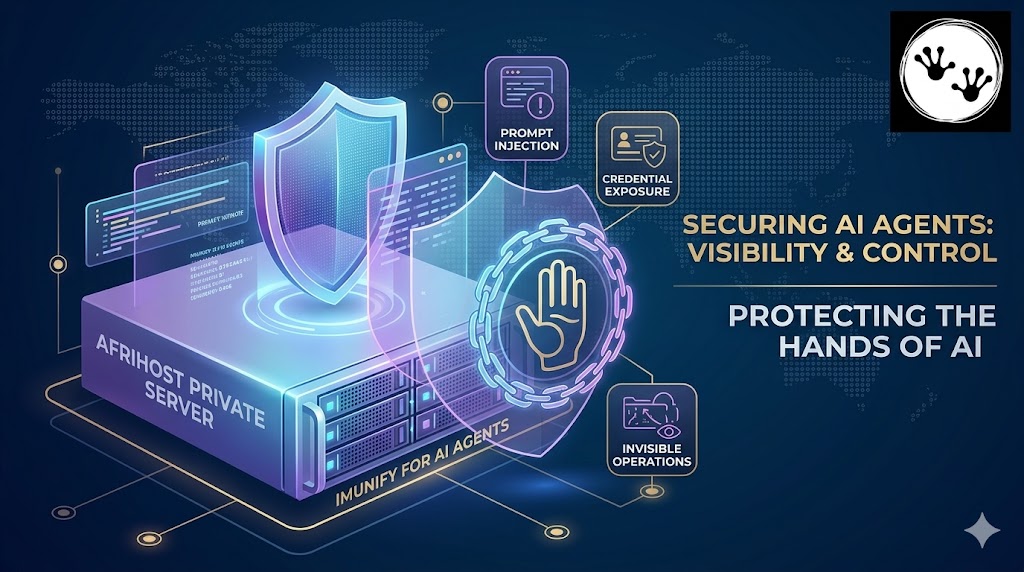
Prompt Injection: An AI agent might read an email or a webpage containing “hidden instructions” that tell it to delete your files or leak your data. The AI isn’t “broken”—it’s just following orders it shouldn’t have seen.
-
Invisible Data Leaks: If an AI agent is compromised, it can quietly sweep up your API keys, SSH keys, and passwords and send them to an external server in seconds.
-
Zero Visibility: Traditional security looks for “bad” software. But AI agents are “authorized” users, so traditional tools often ignore them even when they start behaving dangerously.
How We’re Protecting You at Pinkfrog
We are proactive about these shifts. Our private server environment at Afrihost is now equipped with Imunify for AI Agents.
While others focus on securing “what the AI thinks,” we focus on securing “what the AI does.”
| The Feature | What it means for you |
| Kernel-Level Control | We monitor the AI at the deepest level of the server. If an agent tries to do something it shouldn’t, the server stops it instantly. |
| Credential Shield | The system recognizes over 200 types of sensitive data (like passwords and API keys). If an AI tries to move them, it’s blocked. |
| Human-in-the-Loop | For any high-risk action (like running a system command), the AI is “paused” until a human reviews and approves the request. |